AI governance
The most expensive thing AI does in our businesses
It's not about replacing people. It's about pitting colleagues against each other. Costing of workslop and return to the principle of responsibility.
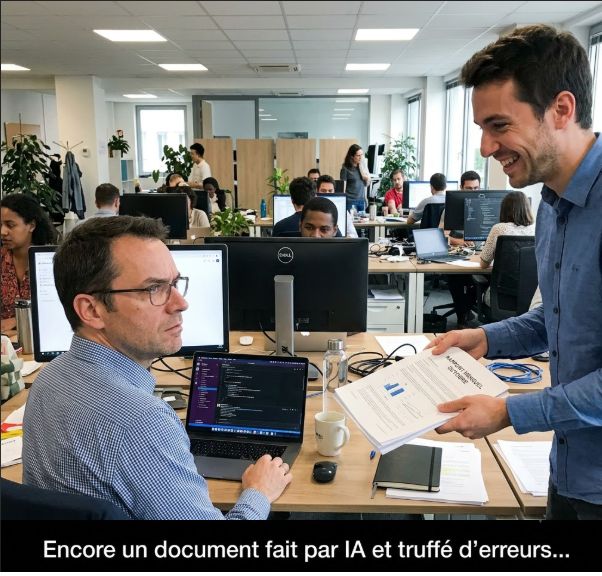

We measure AI with sometimes the wrong indicator: pilots launched, licenses purchased. And almost no one notices what is happening more and more in companies: one employee sends another a perfect document… but empty, full of errors or even sometimes “insert the correct value”.
Researchers from BetterUp Labs and the Social Media Lab at Stanford put a word on it this year: “workslop”. It's AI-generated work that looks finished and square, but contains none of the thought and data needed to move the topic forward.
In a survey of 1,150 American employees, 41% said they had received them in the past month. Each case took them an average of 2 hours to sort out. Converted into salaries, that's about $186 per employee per month, or more than $9 million per year in a company of ten thousand people. And none of this shows up on a dashboard.
Beyond the financial, another aspect emerges from the study: 42% of those who received workslop subsequently trusted the sender less, and a third no longer wanted to collaborate with him at all.
The METR laboratory conducted a controlled experiment in 2025 with experienced engineers. With AI tools and without hands-on training, they were 19% slower. When interviewed afterwards, they were convinced that AI had made them 20% faster. We don't feel the cost of our own workslop. You feel productive while the organization around you slows down.
The concern here is simpler than technology: loss of responsibility.
On an industrial project, no one — I hope — sends a plan that they have not checked and signed. The signature is the control. Work produced with AI deserves the same discipline. What a collaborator generates is a draft to which he responds, not a deliverable that we forward without touching it.
The leaders set the tone: fewer artifacts produced by the machine, more documents truly reread, and we value this discreet verification work that AI makes so easy to skip. The companies that get ahead of the curve will be those that hold everyone accountable for what bears their name, regardless of the tool that produced it.
My research always comes back to the same principle: a system functions based on its governance, not its equipment. AI hasn't changed that. It just increased the price of forgetting.