CIECC Training · Human capital
Training for the energy transition: sector-wide workforce planning, clusters and the people case
200,000 people to recruit, 400,000 to train per year, 100,000 reached in 2024. Without a training system sized to match, an energy trajectory remains an intention.
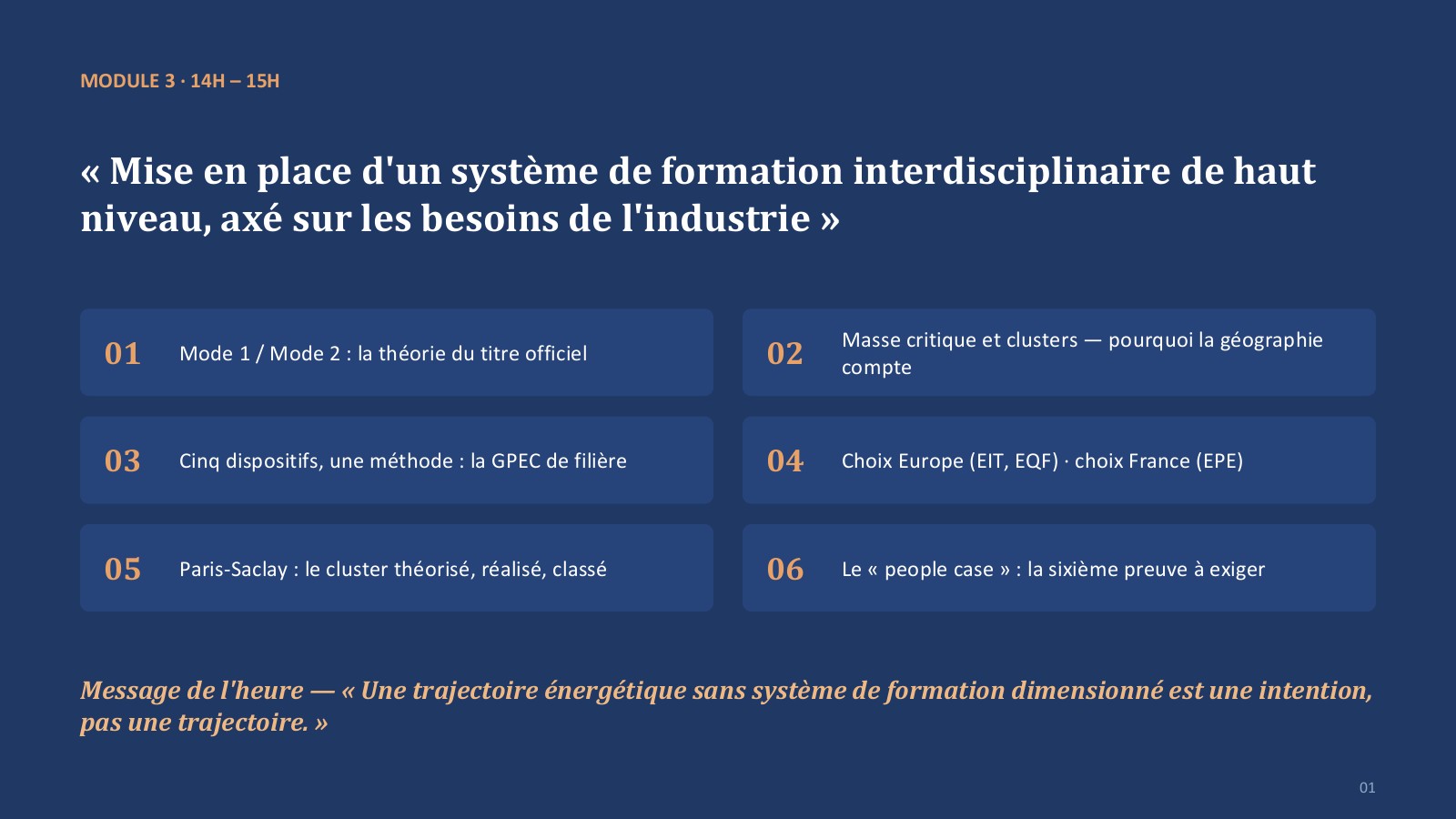
The morning's debt: 200,000 people
This third module of 17 July 2026, in the CIECC training at IEAM Paris, starts from a balance left over from the morning. Around 100,000 hires announced for the nuclear sector alone, across life extensions, EPR2 and modular reactors. More than 100,000 low-carbon jobs by 2030 across photovoltaics, offshore wind, hydrogen, grids and building renovation.
The morning had shown that capital is available and that technologies are coming down their curves. The limiting factor is human, and a training system is designed, sized and audited like a project.
Mode 2: the theory behind the title
The phrase "interdisciplinary training geared to industry needs" has a theory behind it: the Mode 2 knowledge production described by Gibbons, where knowledge is produced in its context of application, in transdisciplinary teams, with broadened quality control.
The critical reading was set out immediately. Mode 2 is a balance, not a replacement. Today's applied knowledge lives off yesterday's fundamental research, and draining Mode 1 dries up Mode 2 ten years later.
Critical mass and clusters: why geography matters
Three externalities justify geographic concentration: a skills pool, specialised suppliers and fast circulation of ideas. A cluster combines co-located competition and cooperation. The advantage is built, it cannot be decreed.
Five schemes, five horizons, five volumes
Five schemes were compared, from work-study and apprenticeship, which train technicians and skilled workers on the actual craft, through to the doctorate.
The CIFRE scheme was detailed as a three-signature instrument with two-way learning: the State subsidises the company for three years, the company employs the doctoral researcher on a subject that matters to it, and the laboratory supervises the thesis. The doctor learns industry and industry learns research.
Sector-wide workforce planning: from gigawatts to occupations
The methodological deliverable of the module is workforce and skills planning at sector level, run in five steps like a project. The first consists of translating the trajectory into workload: converting the gigawatts of PPE3 into work hours by phase.
Applied to PPE3, the method produces three readings of the gap. Offshore wind moves from 3.6 to 15 GW in five years, a factor of four on offshore welders, at-sea maintenance technicians and cable engineers: a bottleneck where every project is counting the same people as its neighbour. Nuclear, with 57 reactors and six EPR2, requires qualified welders, boilermakers and safety engineers whose lead time to produce is counted in three to five years. And cross-sector competition means the same occupations, welding, industrial electrical work, project management, are counted twice by sectors recruiting at the same time. The consolidated gap is therefore worse than the sum of the declared gaps.
My field experience confirms this point: scarce skills are reserved years before first steel. Workforce planning is a contract subject, not only a human resources one.
What France has put in place
The talent lever of France 2030 targets 400,000 people to be trained per year for future-facing occupations. The official April 2025 review reports 100,000 reached in 2024, a quarter of the target rate. Two of the six levers are devoted to human capital, talent on one side, excellence of research and higher education ecosystems on the other.
Discipline on the status of figures was maintained on the most political subject of the day: 100,000 out of 400,000 is a rollout status, not proof of sufficiency. The proof would be convergence between the flow of trained people and consolidated gaps, occupation by occupation.
European choices, French choices
The European layer rests on three instruments, including the European Institute of Innovation and Technology and its energy-focused community, which integrates training, research and entrepreneurship at continental scale, with master's programmes co-designed with industry.
The French bet is to consolidate in order to exist. A landscape historically fragmented between universities, grandes écoles and research organisations remains invisible separately in global competition. The experimental public institution status provides a legal framework for reaching critical mass without standardising everything.
Paris-Saclay: the cluster theorised, then realised
The running case is Paris-Saclay, with its 2025 ranking performance: thirteenth in the Shanghai ranking, a sixth consecutive year in the global top 20, first in continental Europe, second worldwide in mathematics. And, stated frankly, weaker positions in other rankings, sixty-fourth and seventieth depending on methodology.
That is the application of the seventh trap from the previous day: a ranking mostly measures research, and the gap between methodologies has to be stated. Reading it through the module's framework shows a critical mass threshold crossed, with around 220 laboratories and a training-to-research continuum, but also real coordination costs.
The people case: the sixth proof
The proposal I put to the delegation is a methodological addition. The classic five-case business case model treats skills only implicitly, inside the management case centred on the project team. Experience on major programmes shows that this is insufficient.
The people case requires demonstrating, with figures, that the skills the project needs exist or will be produced in time. Five audit questions make it up, two of them discriminating: are the critical occupations named, quantified by phase and set against the pool actually available, and is cross-project competition on those occupations consolidated, or is each project counting the same people twice.
The module ended on a design deliverable, a sector academy in six blocks, owned by the sector with the State and the regions as co-funders. The academy executes workforce planning, it does not invent it.