CIECC Training · Platforms & Data
Urban digital platforms and industrial digitalisation: opening the black box
An urban platform is a two-sided market. Awarding it means awarding a position of power. A four-layer architecture, three data rules, NIS2 and twelve technical specification requirements.
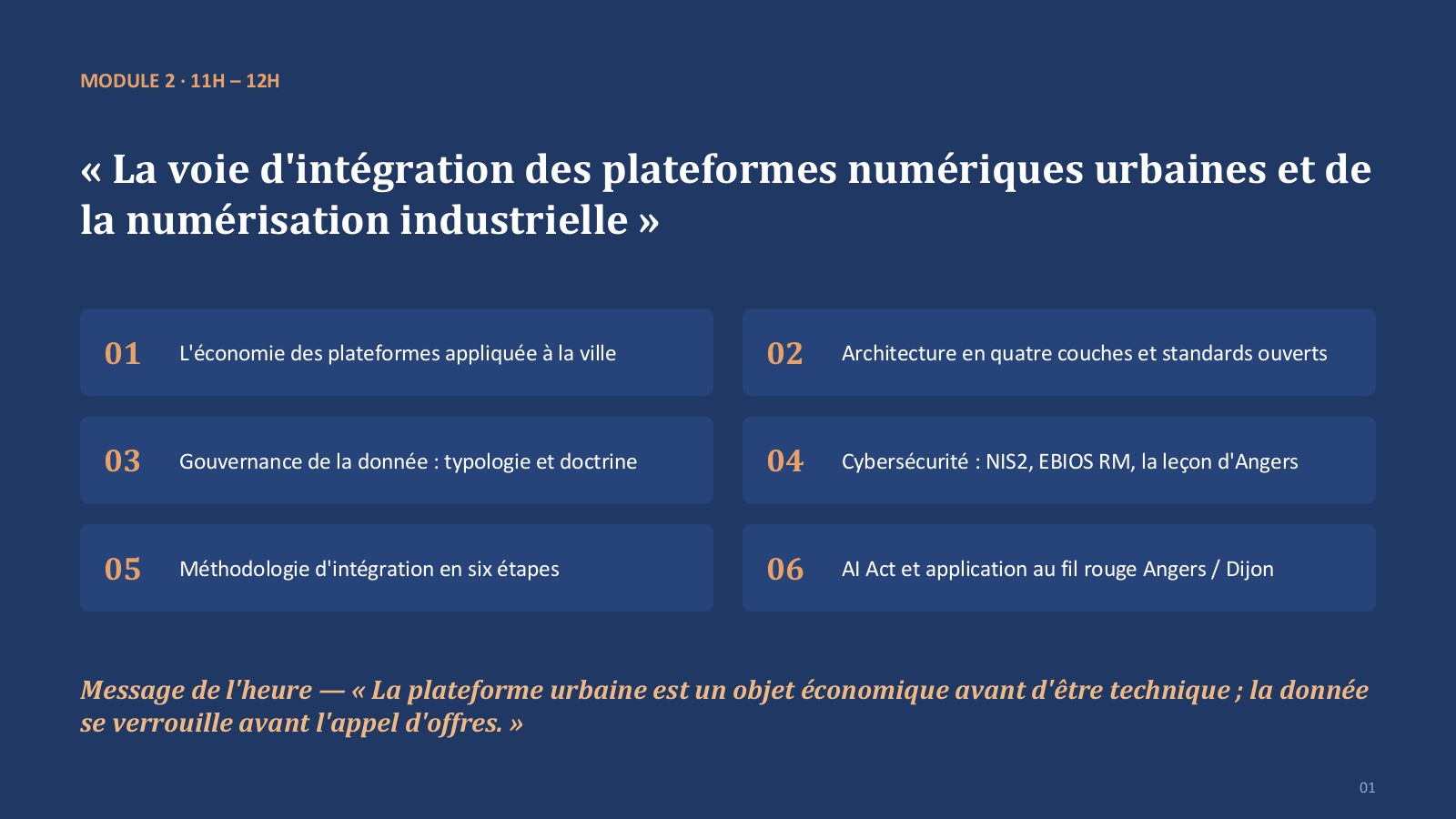
Whoever governs the data governs the chain
This module of 13 July 2026, the second hour of the CIECC programme at IEAM Paris, picks up the choke point identified in the morning: it sits between the data layer and the service layer. The purpose of the module is to show how it is held, through economics, through law and through security.
The platform is a two-sided market
An urban platform belongs to the two-sided market economics described by Rochet and Tirole. More users attract more service developers, and vice versa. Value grows with size, non-linearly, and the operator positioned between the two sides sees every flow and sets the access rules.
Hence the lock-in mechanism. Data, configurations, historical records and models accumulate in proprietary formats. Every additional contract year raises the cost of leaving. Exit cost is not a clause, it is a trajectory.
Four-layer architecture and open standards
The structural answer is architectural. A four-layer reference architecture makes contracts decoupleable: each layer can be awarded, audited and replaced separately. Architectural value lies in the interfaces, not in the building blocks.
Open standards are the condition for that. The FIWARE components for urban context management, with the Context Broker as the exchange core, are reused across Europe. The standardised NGSI-LD API then becomes the first requirement to write: every data set exposed through a documented open standard.
Three data rules, turned into clauses
Not all urban data is governed by the same law. The GDPR and CNIL doctrine frame personal data, with impact assessment, minimisation, retention periods and processing subcontracting framed by article 28. The European Data Governance Act organises circulation and introduces neutral data intermediaries, trusted third parties with no interest of their own in the data.
From doctrine to clauses, three rules become enforceable: public ownership of all data including derived data and aggregates, anonymisation at the point of collection when the purpose allows it with minimisation documented per use case, and a ban on monetisation by the operator.
Four practical reflexes complete the framework in urban practice, including a mandatory impact assessment before any video surveillance deployment, and not after.
January 2021: the Angers lesson
In January 2021, a cyberattack hit the city and metropolitan area of Angers in the middle of the Territoire Intelligent rollout. Systems paralysed, services degraded: the most advanced project in France discovered that its attack surface was the whole territory.
The NIS2 directive then changes the scale of the obligation, extending cybersecurity requirements to essential and important entities, including local authorities and urban operators, with mandatory reporting of significant incidents. ANSSI's EBIOS Risk Manager method structures the analysis in five workshops, from the compliance baseline to realistic attack scenarios.
Six integration steps, two irreversible ones
The proposed methodology has six steps, two of which cannot be recovered later.
Data governance must be settled before the tender. Afterwards, it can only be bought back at a high price. And cybersecurity must be built in from design: Angers learned that in 2021 at the cost of a complete overhaul.
AI Act: the deadline that concerns critical infrastructure
The module treated the AI Act as risk-based regulation, with prohibited practices, a high-risk category including critical infrastructure, and seven associated requirements: continuous lifecycle risk management, data set quality and relevance, technical documentation, traceability, transparency, human oversight, and robustness and cybersecurity.
The calendar was presented with an immediate deadline for the delegation: general application on 2 August 2026, sixteen days after the session, with sanctioning powers and mandatory regulatory sandboxes.
The deliverable: twelve requirements on two pages
The module closed on a directly usable deliverable, a template for the technical specification clauses condensed into twelve numbered requirements, E1 to E12. It starts with the NGSI-LD open standard API and documented data models, and integrates the three governance rules under references E4 to E6.
The guiding idea fits in one sentence: awarding an urban platform means awarding a position of power, and open standards are what keeps that position in check.