CIECC Training · Measurement & evaluation
Industrial modernisation through data: measuring value without confusing evidence categories
Four families of evaluation, seven traps that invalidate published results, two quantified French cases and a twelve-indicator executive dashboard.
One thing remains to be done: prove it
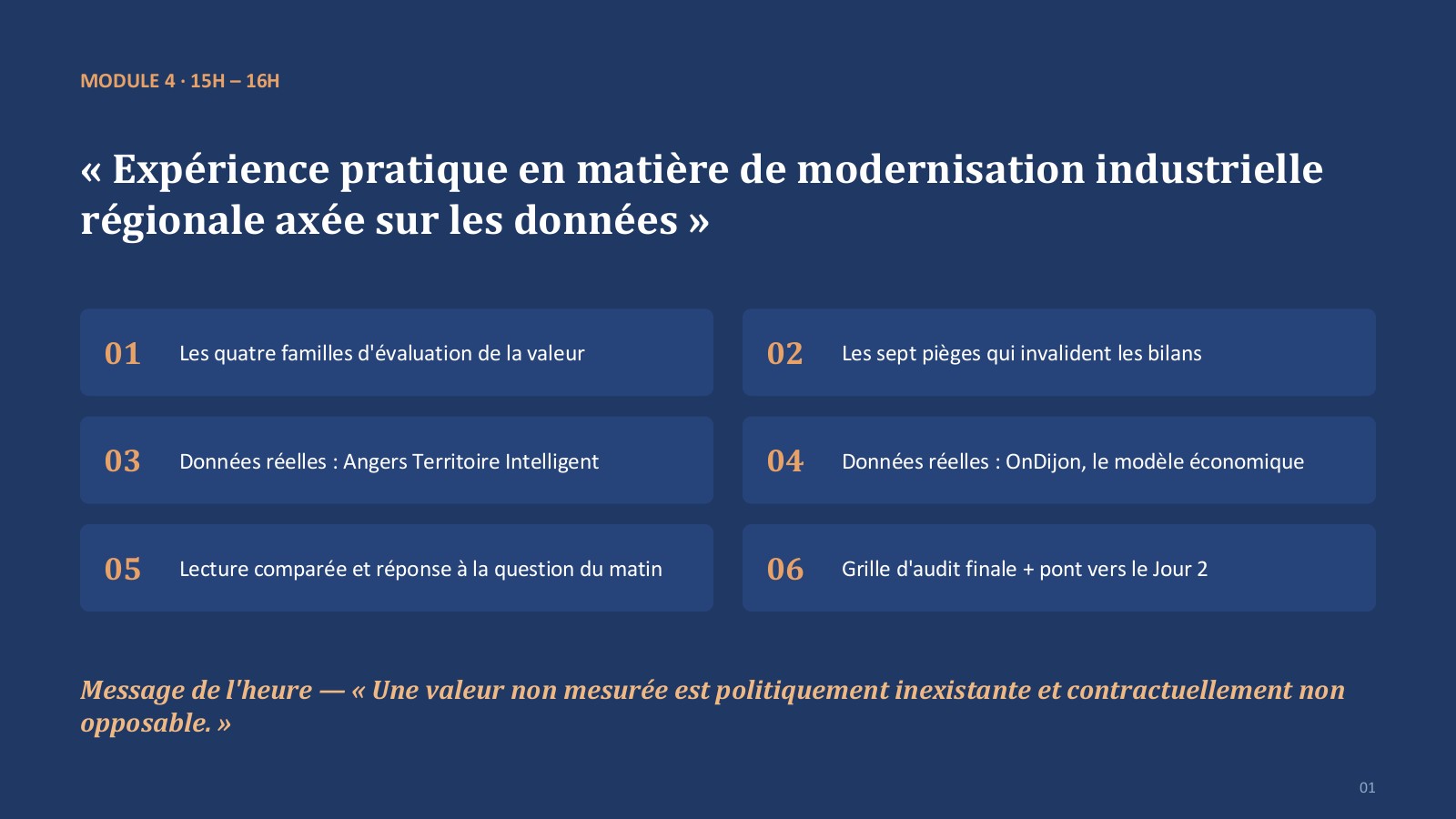
This fourth module of 13 July 2026 closes the CIECC day on the question raised in the morning: how to turn digital urban infrastructure into measurable industrial growth. The first three modules laid the foundations, opened up the mechanics and covered the contract. What remained was the demonstration.
Four families of evaluation, four uses
Before any figure, ask which family it belongs to. Ex ante socio-economic cost-benefit analysis produces a forecast under assumptions. Status description describes a rollout without demonstrating any value. Measurement and verification (M&V) produces a verified saving, adjusted for external variables. Impact evaluation looks for the counterfactual.
The family that triggers a payment is the third. It is the one that makes performance enforceable, and the only one that allows an economic model to be demonstrated.
Seven traps that invalidate published results
The module detailed seven methodological traps, two of which were worked through on real cases.
Attribution bias first: the 27,000 cubic metres of water saved in Angers in 2022-2023 correspond to two years of drought and water restrictions, and the figure is usable only because it was adjusted for climate. Then the deadweight effect: simple equipment replacement would have produced part of the gain attributed to the project.
The hierarchy of evidence was made explicit: testimonials and use cases are the weakest level, useful for understanding and not for concluding.
Angers 2026: every figure with its status
The Angers figures were reviewed line by line. The 27,000 cubic metres of water and the 60% drop in young tree mortality fall under measurement and verification, therefore a verified and enforceable saving. The 400 sensors representing around 30% of the target, the 450 cameras and 180 remotely monitored buildings fall under status description: a rollout described, no value demonstrated in itself. The control centre moving from 9 to 18 staff describes installed capacity. The Forum and the Ineo Lab, around 300 square metres opened in spring 2026, along with the territorial artificial intelligence strategy, constitute a body of indications that the ecosystem is being pulled along, not proof of impact.
The rule of language was set: say verified saving, rollout status or body of indications, never a bare figure.
OnDijon: the economic model demonstrated
OnDijon was covered for what it demonstrates best. A design-build-operate-maintain contract of €105 million over twelve years started on 1 February 2018, of which €53 million in public funding combining the metropolitan authority, the city, the region and European funds, 23 municipalities and six command posts merged into one, a connected control centre opened in April 2019 across 1,200 square metres with around 50 staff and 53 screens.
The rollout is described in status terms: 140 kilometres of optical fibre, 113 connected junctions, 180 buses with traffic light priority, more than 200 geolocated vehicles, 600 terabytes of data spread across two data centres, around 630 incident reports handled per day and more than 450 procedures.
The economic demonstration lies elsewhere, in the reinvestment loop: around 65% energy savings targeted on street lighting converted to remotely managed LED, around €7.8 million of operating gains announced over 2020-2026, and a doubled renovation pace with 10,000 lighting points handled in two years against 5,000 planned.
The same rigour was applied to the figures themselves: around 65% is a contractual target, around €7.8 million a gain announced by the metropolitan authority, the doubling an observed acceleration. Three different statuses, named as such. And an acknowledged caveat on data freshness: OnDijon's public operating data mostly dates from 2021-2022.
The industry and attractiveness channels
On the industry channel, OnDijon documents 45 direct jobs in the area and Data Challenges funded with €20,000 on open data. On the attractiveness channel, Angers is building a third-generation setup with its Forum and its Lab. The status of these elements was stated plainly: a body of indications, not proof of impact.
Four conditions, one checklist, one dashboard
The answer to the morning's question comes down to four conditions, necessary together and insufficient separately. A performance contract with quantified targets backed by a measurement and verification protocol, without which value stays declarative. Data governed upstream. Installed client-side capability. Channels into the real economy explicitly measured.
Two deliverables closed the day. A twelve-indicator executive dashboard spread across the four families, not one more. And an audit checklist allowing a project to be judged in ten questions, starting with the most discriminating one: was the problem stated before the solution.