CIECC Training · Scientific mobility
International mobility of researchers: from brain drain to organised circulation
Choose Europe for Science, €500 million over 2025-2027, a doubled ERC top-up, and a 130% rise in applications from outside the European Union. What those flows prove, and what they do not.
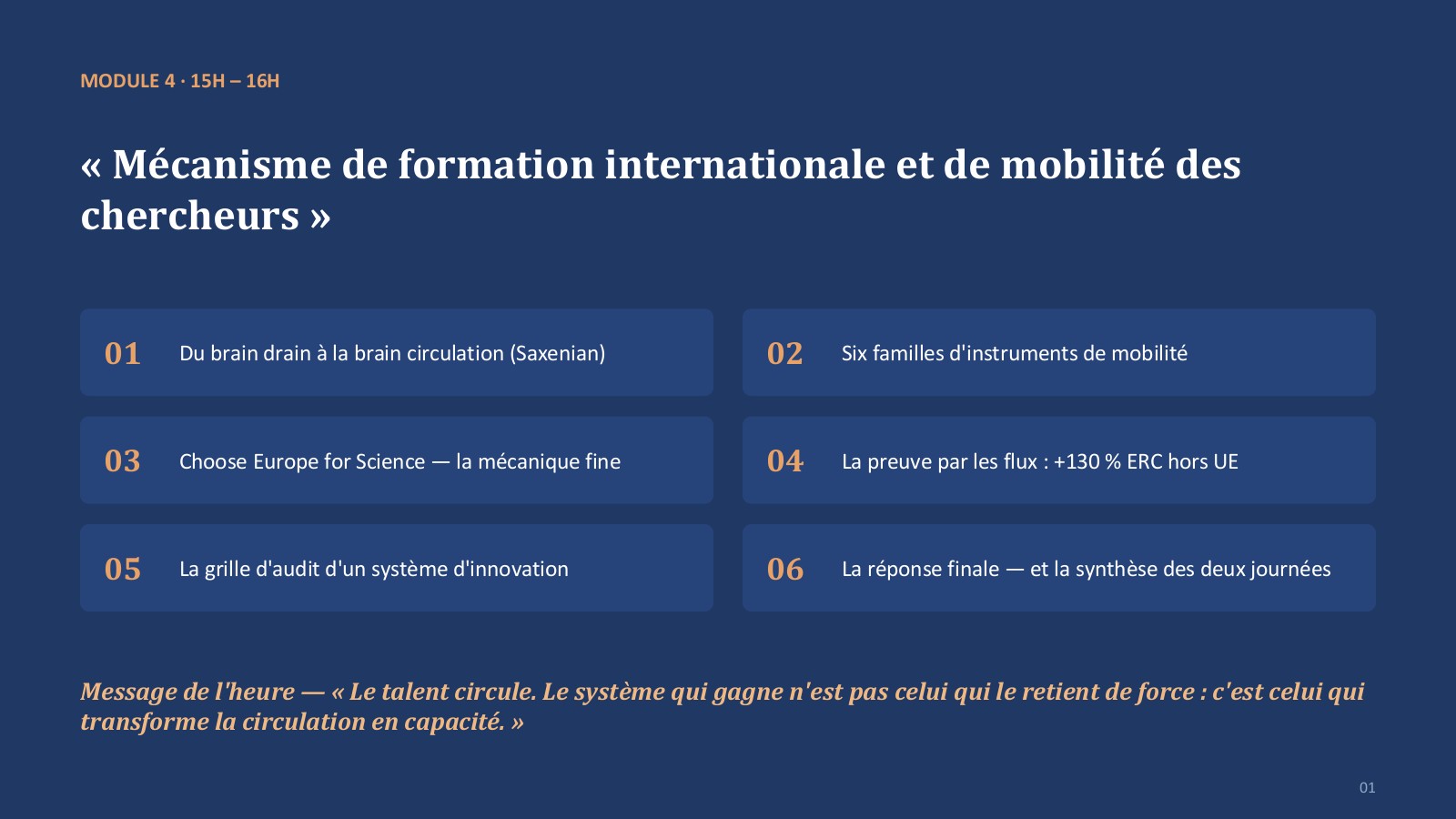
Training is not enough: talent moves
This fourth and final module of 17 July 2026 closes the CIECC training at IEAM Paris. The previous module sized the training effort. This one covers what happens next: no country trains on its own all the talent its trajectory needs, and science is an international network activity. A system that can neither attract nor retain is training for others.
Three readings of scientific mobility
Brain drain describes an accounting loss. Brain gain reverses the game. Brain circulation describes a network where movement in both directions creates value on both sides.
Saxenian, with her New Argonauts, provides the demonstration: the Taiwanese, Israeli and Indian engineers of Silicon Valley did not flee, they built bridges in capital, orders, standards and teams. The scientific diaspora is therefore not a loss to lament but an asset to organise, each departed researcher being a potential network node.
What turns drain into circulation comes down to absorption institutions: funded laboratories, attractive positions, research autonomy. In other words, the capacity to host the return.
Six families of mobility instruments
The module compared six families of instruments, from individual grants and fellowships that fund the person who moves, through to administrative facilitators and visa schemes.
The reading grid proposed maps each family to an objective: attract, retain, or organise circulation. The resulting audit question is concrete: does the package cover relocation and the long horizon, or only the first year.
Choose Europe for Science: the fine mechanics
On 5 May 2025 at the Sorbonne, Europe took its position. An envelope of €500 million over 2025-2027 dedicated to attracting researchers, a relocation top-up linked to ERC funding doubled to up to €2 million in additional funds, long seven-year funding, and the announcement of European legislation intended to write academic freedom into law in the second half of 2026.
The interest of the module was not the announcement but the mechanics: each measure addresses a specific friction. The doubled top-up addresses the real cost of relocation, moving a laboratory, a team, a family. Seven-year funding addresses the horizon, because a senior researcher does not move for three years of visibility. The mobility rule in European programmes addresses the eligibility of the target audience. A European scientific visa addresses administrative friction by replacing twenty-seven entry points with one. And writing academic freedom into law addresses trust, which is the argument money does not buy.
The design lesson is explicit: a good mobility scheme does not stack up bonuses, it dismantles frictions one by one.
The French layer
On the French side, Choose France for Science mobilises €100 million, operated through a National Research Agency platform co-funding host arrangements with institutions. The talent-researcher passport provides a dedicated visa. Around 8,000 government scholarship holders make up the long-term inbound flow, meaning today's doctoral researchers and tomorrow's bridges. Finally, a targeted hosting scheme run by a French university takes on a positioning as a place of refuge for researchers whose academic freedom is under threat.
The division of roles is clear: Europe sets the framework and the envelope, France operates the hosting.
Proof through flows, and its limits
The state of flows as at 30 January 2026 was presented, then immediately qualified.
A 130% rise in European applications from outside the Union measures an intention, not a relocation: conversion from application to installation and then to permanence is still to be observed. The volumes must be stated, around 115 applications, some sixty host placements and 25 fellowships on one targeted scheme: clear signals on modest volumes, significant as a trend and not in absolute terms. And one year of data in exceptional circumstances does not allow a window to be distinguished from a trend.
The exact status of these elements was named: a body of converging indications. That is what can honestly be said, and it is already a lot.
Auditing a whole system in ten questions
The final deliverable of the two days is a ten-question audit checklist for an innovation system. Are the missions dated, measurable and limited to a manageable number, or is this a catalogue. Is every technology maturity segment covered on both push and pull. Are selection rules open and independently reviewed, or discretionary.
The answer to the question of the day comes in three storeys on one foundation. Mission-oriented patient capital, which equips the valley of death and reduces the cost of capital through visibility. Technologies coming down their curves, conditional on degressive support. Skills produced at the right pace. And as a foundation, measurement discipline: stating each time which type of figure is being discussed.
The two days close on a single grammar at two scales, that of the urban contract and that of the national system, with the same starting rule: the problem before the solution.