CIECC Training · Consulting & public procurement
The role of consulting firms in smart city projects: mapping and regulation
No French smart city has been built without consulting firms. Public spending figures, a Senate inquiry commission, a re-insourcing circular and three ethical red lines.
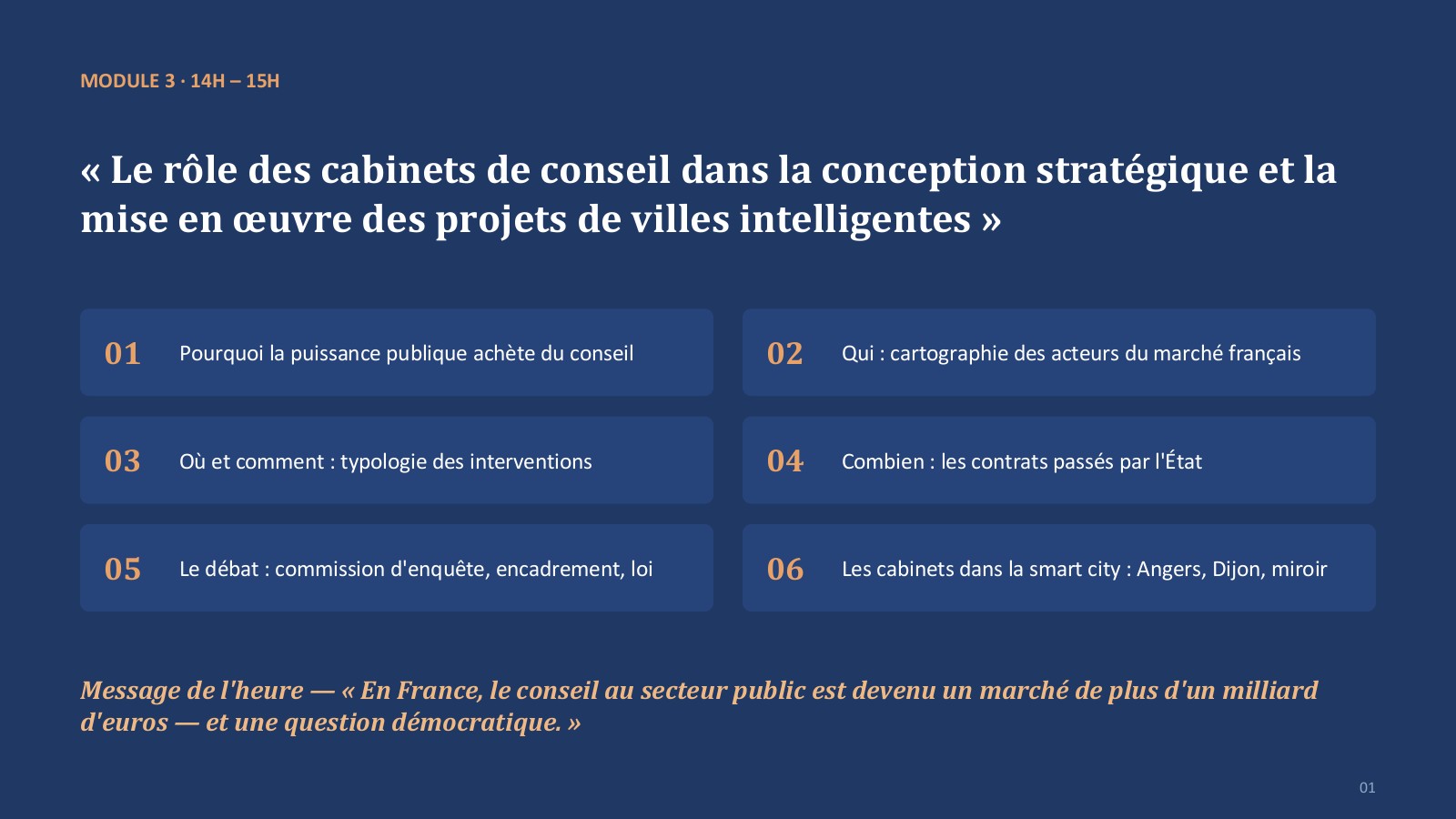
Who helps public authorities think and deliver
This third module of the 13 July 2026 session, at IEAM Paris, covers a subject rarely documented in front of a foreign delegation: the real role of consulting firms in French urban projects, backed by public figures.
No French smart city has been built without consulting firms, whether for upstream studies, tender documents, integration or evaluation. The module maps that involvement factually, then sets out how it is regulated.
Why the State and cities buy consulting
Three documented reasons. Scarce expertise not held in-house, particularly on data architecture, cybersecurity and complex contractual structures. An outside view and a method, meaning benchmarking and structuring that the administration rarely applies to itself. A workload peak, when an exceptional programme exceeds the capacity of existing teams.
Four families, three circles, one boundary
French public sector consulting is split across four families of players, from generalist strategy firms to technology consulting and audit firms.
Around cities, three further circles apply: territorial strategy firms, the engineering companies and technical client-side advisers that carry French territorial engineering, and systems integrators. The important boundary is the one separating the adviser from the operator: confusing the two is the first analytical error.
Four entry points across a project cycle
Consulting comes in at four moments: diagnostic and master plan with business case, procurement preparation, delivery support, then evaluation. The Angers case illustrates the first entry point, with a maturity diagnostic run by Wavestone comparing the metropolitan authority with four other French metropolitan areas.
Five types of assignment correspond to five different positions towards the client, which determines the level of independence expected.
How much: the public figures
State consulting spend more than doubled between 2018 and 2021. Published work reports €893.9 million for government ministries and €171.9 million for forty public agencies, with a total the inquiry commission described as understated. The increase is concentrated: strategy and organisation consulting multiplied by 3.7, information systems strategy consulting multiplied by 5.8 over the same period.
Purchasing channels explain part of the phenomenon, notably interministerial framework agreements activated through purchase orders, which the Court of Auditors described in 2023 as a path of least resistance.
2021-2022: consulting becomes a matter of State
The disclosure of a major firm's role in the logistics of the vaccination campaign brought the subject into public debate. A Senate inquiry commission followed, with hearings under oath and around 7,300 documents collected.
Beyond the amounts, four criticisms were raised. Incomplete, non-centralised data. Consultant deliverables presented without any mention of their origin. Use of consultants becoming reflexive. And a loss of the administration's capacity to deliver, and even to judge what it buys.
Regulation: circular first, then legislation
The immediate response was a January 2022 circular setting quantified targets for reducing consulting spend, minus 15% in 2022 and minus 35% in 2023 against 2021, together with a re-insourcing doctrine.
The legislative response, coming out of the inquiry commission and adopted unanimously, is still moving between the two chambers. The revised text extends the framework to local authorities above 100,000 inhabitants, which directly concerns the metropolitan authorities running smart city projects.
Local authorities remain the least regulated case. A metropolitan authority has neither the headcount nor the specialisms of a ministry, and for a smart territory project client-side advisory is not a comfort but a condition of market access. There is no consolidated local equivalent of the State budget documents for consulting expenditure.
Two opposite models: Angers and OnDijon
In Angers, consulting sits upstream and operators are under contract. Wavestone delivers the maturity diagnostic, identifies data management as the weak point, and that conclusion is written into the functional programme and the December 2018 tender documents. That is the lasting imprint of consulting.
In Dijon, the integrator absorbs the consulting. The OnDijon design-build-operate-maintain contract, worth €105 million over twelve years, is held by a consortium bringing together Bouygues Énergies et Services as lead contractor, Citelum, Suez and Capgemini, the latter holding digital integration. One accountable party, internalised interfaces, an obligation of results.
Three red lines and a purchasing method
Three ethical rules were set out, the first being that whoever evaluates does not deliver. A firm does not provide independent review of a project whose design and engineering work it hopes to win, and a client-side adviser cannot be linked to the bidders whose offers it is analysing.
Finally, buying consulting without buying dependency requires one simple rule: a consulting scope of work describes a problem and a deliverable, never an expected conclusion.