PMI Conference · Project governance
Neutralizing transcontinental asymmetries: from the board of directors to the construction site
A governance framework to link information, authority, contracts and trust on Europe–Africa projects.
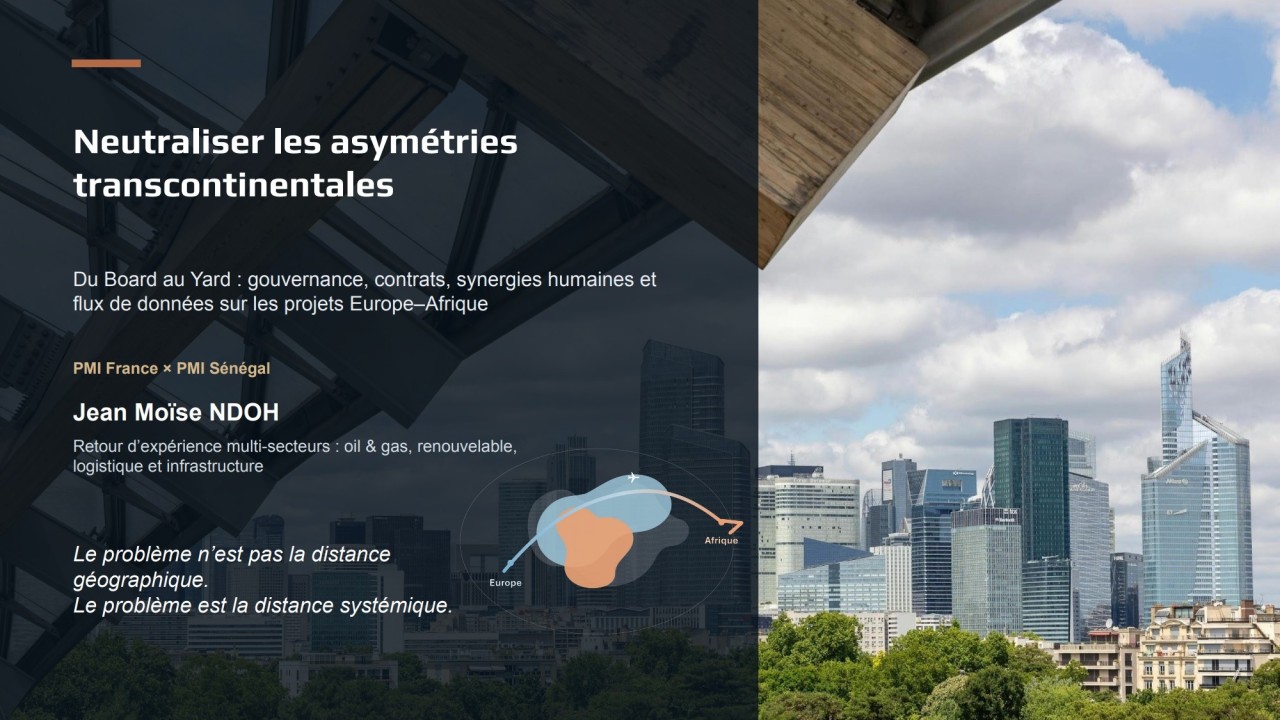
Geographic distance is only part of the problem
On a Europe–Africa project, the map can give the impression that the main difficulty is the thousands of kilometers between headquarters and the site. This distance exists, but it does not in itself explain why competent teams, equipped with the same tools and committed to the same objectives, sometimes end up working on two different realities.
The real difficulty is systemic. Information, decisions, contracts, processes and reality on the ground do not always circulate at the same speed. Headquarters reads a consolidated reality, often filtered by multiple levels of validation. The site manages an immediate reality made up of availability of resources, access, logistics, security, local relations and unforeseen events. Both logics are legitimate. The risk appears when they stop being synchronized.
This is the starting point of my presentation for PMI France and PMI Senegal: “The problem is not geographical distance. The problem is systemic distance. » Neutralizing this distance requires fewer meetings and more clarity in the design of the decision-making system.
Three asymmetries that degrade performance
The first work consists of mapping three forms of asymmetry.
The first is information asymmetry. Headquarters can decide based on partial, delayed or politically reprocessed information. The field has fresher facts, but not always the language, psychological safety or channel necessary to surface them without distorting them.
The second is process misalignment. Contract validations, purchasing, customs, planning, mobilization and execution can follow incompatible cadences. The cost of an event is immediate on site, while its approval may wait for several signatures. The risk then moves faster than the authority responsible for dealing with it.
The third concerns intercultural frictions. They say nothing about the value or competence of people. They reflect different relationships to hierarchy, time, conflict, trust and the way of announcing bad news. “What breaks the project is not diversity. It is the absence of translation between the codes. »
These asymmetries reinforce each other. A late alert fuels a slow decision. A slow decision creates additional cost. The additional cost becomes a contractual subject. The contractual subject deteriorates the relationship. A local difficulty thus ends up becoming a drift in cost, time and confidence.
Get out of the watermelon effect
One of the most well-known symptoms is the watermelon effect: green on the outside, red on the inside. The dashboard appears to be under control while difficulties accumulate under the aggregate indicators.
The problem is not necessarily the tool. “Your dashboard doesn’t lie. It’s often your incentive mechanisms that distort it. » If a team is penalized each time it reports a problem, it will learn to delay the red, smooth out the information or wait until it has a solution before alerting. The management system then ceases to protect the project and begins to protect people against the system itself.
Three managerial decisions make it possible to change this dynamic. We must first establish the right to red: a red, factual and documented indicator is better than a comfortable green. We must then recognize early warning as a professional act. Finally, we must separate data from judgment. The field reports the facts, their probable causes and their effects. Management interprets, arbitrates and decides. Confusing these roles politicizes data before it can even be used.
This discipline requires an explicit alert protocol: threshold, recipient, response time, proof format and decision level. Critical alerting should not depend on an informal exchange or a manager’s personal ability to get headquarters’ attention.
Align contract, authority and processes
The contract, delegation of authority and processes form a speed triangle. The contract structures the obligations and rights. Delegation places decision-making capacity at the appropriate level. The process maintains the traceability necessary to act quickly without losing control.
“The best governance is not the most centralized; it’s the clearest. » Delegating everything would be imprudent. Putting it all back together would be paralyzing. Good architecture distinguishes between routine decisions that the field can take, those that require consultation with headquarters, those that require co-decision and those that require formal escalation.
For each level, four elements must be known before the crisis: the limits of authority, the minimum proof expected, the maximum response time and the person responsible for the decision. Decision-making power must follow useful information, not just the organization chart.
Contractual engineering completes this architecture. The clauses, variation thresholds, notification deadlines, responsibilities and documentary rules must correspond to the reality of execution. Contract notices, signed minutes, change orders and decision logs are not peripheral bureaucracy. They constitute the defensible memory of the project.
Design trust as an execution asset
Confidence is often classified as a soft skill. On a transcontinental project, it is much more concrete. It determines the speed at which bad news is reported, the quality of information not yet formalized and the ability to resolve a crisis before it becomes a conflict.
“Confidence is not a soft skill; it is an execution asset. » It is built before the project by understanding the actors, local constraints and formal or informal networks. It is maintained during execution through regular exchanges which do not rely solely on email. It can be mobilized in a crisis when the truth must be quickly obtained, access secured or unnecessary escalation avoided.
This trust requires leadership presence in three forms. Physical presence consists of going on site and looking at reality without the exclusive mediation of a report. Symbolic presence consists of speaking the language of the field, knowing the constraints and recognizing people. Decision-making presence consists of deciding when the information is sufficient and the delegation is clear.
Transform a field fact into a traceable decision
Sending more messages doesn't necessarily create better communication. Useful communication transforms a fact on the ground into an actionable decision.
The chain is simple: factual data, then a qualification, an arbitration and a decision. The facts must include dates, quantities, photos or other suitable evidence. The qualification specifies the cause, the potential effect on cost, time, safety, quality and the contract. Arbitration identifies the right level of authority. The decision designates who does what, for when, on what hypothesis and with what review date.
Each critical subject must therefore have an owner, a deadline, proof and a decision level. A common source reduces parallel versions. Reviews adapted to each level avoid drowning the field and management in the same mass of information. The daily cadence serves execution, the weekly review serves management, the monthly review serves the portfolio and the periodic committee serves structuring decisions.
The Board-to-Yard Bridge
The model presented at PMI connects the board of directors, headquarters, project management and the site through three bridges: clarity of information, alignment of authority and intentionally designed trust. Its foundation is the presence of leadership.
It applies to different sectors: offshore operations, prefabrication workshops, photovoltaic projects, ports, mobility, cables and last mile infrastructure. The constraints change, but the discipline remains the same. The execution environment is part of the real scope. Physical access, connectivity, seasonality and communities are not logistical details. These are decision parameters.
To begin, a project manager can choose five actions: audit a flow of critical information, recalibrate a decision threshold, formalize a headquarters-site ritual, clarify a contractual point at risk and plan a field presence oriented toward listening. The criterion for success is not the sophistication of the device. It is seen in less ambiguity, more speed, better confidence and more robust traceability.
Neutralizing transcontinental asymmetries does not therefore consist of erasing the differences between headquarters and site. It is about making them explicit, translatable and governable so that complexity becomes a performance capability rather than a silent source of drift.